What drives the cost of a high-end custom kitchen remodel
By Dana Whitfield · Updated 2026-08-31
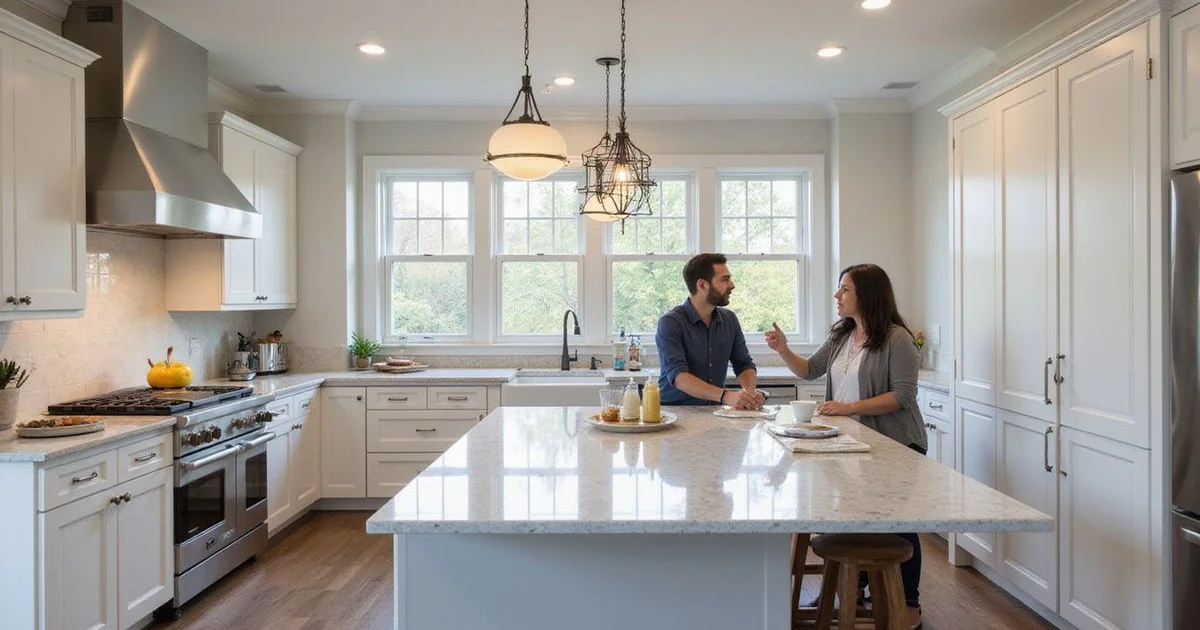
A high-end custom kitchen remodel sits at the top of the price range for a reason: nearly every component is upgraded from the more common mid-range equivalent. Understanding which choices actually drive that cost helps you spend deliberately rather than just watching the number climb.
Custom cabinetry is usually the biggest single factor
Fully custom cabinets are built to your kitchen’s exact dimensions, in your choice of wood species and finish, rather than assembled from standard modular sizes. That customization means more design time, more skilled labor, and materials chosen specifically for your project rather than produced at scale. It is the single largest contributor to a high-end kitchen’s total cost, more than any individual finish choice.
Premium and specialty surfaces
At this tier, countertops often move beyond granite and quartz into marble, specialty stone slabs chosen for unique veining, or waterfall-edge installations where the material wraps down the side of an island in one continuous piece. Each of these choices adds material cost, and specialty installations like waterfall edges also add labor complexity since they require precise seaming and structural support.
Integrated and professional-grade appliances
Built-in refrigeration that matches cabinet fronts, professional-grade ranges, and integrated ventilation systems all cost significantly more than their standard counterparts, both in the appliance itself and in the more involved installation and often the electrical or gas line upgrades that come with them.
Design and project management time
At the high end, the design process itself takes longer and involves more back-and-forth than a stock kitchen: custom drawings, multiple material sampling rounds, and closer coordination between the cabinet maker, the stone fabricator, and the installer. That additional design and project management time is a real cost, even though it isn’t a physical material, and it’s part of what separates a high-end result from one that merely uses expensive materials without the same level of planning behind it.

What actually moves the needle
| Choice | Cost impact | Worth it if… |
|---|---|---|
| Fully custom cabinetry | Highest single factor | You need exact dimensions or an unusual layout |
| Specialty stone or waterfall edge | High | The visual statement matters to you long-term |
| Professional-grade appliances | High, plus install complexity | You cook frequently and use the capacity |
| Integrated built-in refrigeration | Moderate to high | Uninterrupted cabinet lines are a priority |
| Designer lighting and hardware | Lower, but adds up | Small details you’ll notice daily |
Spending deliberately instead of everywhere at once
Not every dollar in a high-end budget delivers equal value. Homeowners who are happiest with the outcome tend to prioritize cabinetry and layout, the things they interact with daily, over chasing the single most expensive option in every category. A slightly less exotic countertop paired with cabinetry built exactly to your storage needs often outperforms the reverse in daily satisfaction.
Lighting and hardware add up more than expected
At the high end, designer lighting fixtures and specialty hardware, custom pulls, integrated cabinet lighting, statement pendants over an island, are often the last items priced but can meaningfully add to the total once selected. They matter for the finished look, but it’s worth setting a rough allowance for this category early rather than discovering late in the project how much these details actually cost once multiplied across an entire kitchen.
Is it worth it for resale
High-end finishes can support resale value, particularly in neighborhoods where buyers already expect that tier of finish, but the dollar-for-dollar return on a fully custom kitchen rarely matches its full cost. If resale is part of your thinking, treat the added value as a partial offset rather than the primary justification for the spend, and remodel first and foremost for how you want to live in the space.
If you are planning a project at this level, work with a high-end custom kitchen specialist who has a track record with the specific materials and appliance integrations you have in mind, since the execution quality matters even more at this tier of investment. Compare custom kitchen remodelers in Connecticut to see portfolios and get detailed quotes before committing, and check our rating methodology for how they’re ranked.
Frequently asked questions
- What separates a high-end kitchen from a mid-range one?
- Mostly customization and material grade: fully custom cabinetry built to exact specifications, premium stone or specialty surfaces, and integrated or professional-grade appliances, rather than semi-custom or stock equivalents.
- Is custom cabinetry worth the extra cost?
- It's worth it if you need exact dimensions, unusual layouts, or a specific wood species and finish that stock or semi-custom lines don't offer. If a standard layout works for your space, semi-custom can deliver a similar look for meaningfully less.
- Do high-end finishes actually add resale value?
- They can, particularly in higher-value neighborhoods where buyers expect that level of finish, but the return rarely matches the full cost dollar for dollar. Treat resale as a partial offset, not the main reason to spend at this level.
- Where should I spend if my budget is high but not unlimited?
- Cabinetry and layout tend to matter more to daily function and long-term satisfaction than every finish detail. Many homeowners get more value putting money into custom cabinet storage and layout than into the most expensive countertop slab available.